


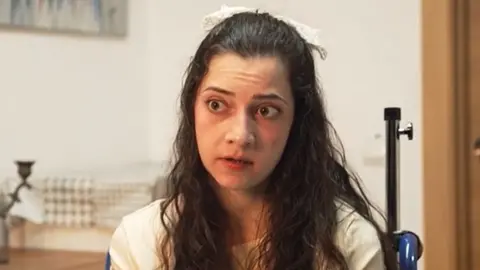
 Y Ahora Sonsoles (Atresmedia Television)
Warning: This story contains mentions to sexual violence and self-harm.
The death by medically assisted death of a twenty-five-year-old Spanish female after a lengthy court fight with her parent has triggered debate about the responsibility of the government in caring for her and why it was so delayed to implement her wish to end her life.
Noelia Castillo, who had been left paralyzed due to injuries sustained when she attempted to end her life in the year 2022, died on Thursday night at a Barcelona hospital.
The Catalan regional government had approved her the right to assisted dying in the year 2024.
However, the process was halted at the last moment after court challenges raised by her father, backed by the advocacy organization a Christian legal group.
The situation has garnered enormous attention in Spain, with the legal group attempting to block her death until the last moment.
Following an year-and-a-half legal battle, the European Court of Human Rights (ECHR) decided this week in Noelia Castillo's favor and her passing was eventually verified in the late hours on Thursday.
A Difficult Past
She had passed much of her early years in care homes and had recounted the effect on her mental health of her parent's issues with alcohol and of being assaulted by an ex-boyfriend and also by several individuals in a nightclub.
In a TV interview this week, she said nobody in her immediate family had supported her decision to undergo assisted death, and her father "did not respect my wish and never would".
"I want to pass in calm now and end suffering," she told a TV network the day before she died.
Her parent had not agreed with her choice but joined her at the hospital.
A former friend of her, Carla Rodríguez, attempted to enter the hospital to persuade her to change her mind, but told reporters that officers had barred her from entering.
A British pianist living in the country made an plea to Castillo via online platforms to think again and offered to pay her healthcare expenses until she felt "in a position to take this choice from a somewhat more tranquil state of mind".
Institutional Shortcomings Questioned
Christian Lawyers argued that her case had underlined failures in her care.
"For a young woman who obviously has had a very tough life, which we all regret, the sole option that could be provided to her by the healthcare system is death," stated a spokesperson for the group.
The main right-leaning party, which opposed a 2021 euthanasia law, had a comparable reaction.
"The institutions that should have protected Noelia let down her," posted the party's leader on an online platform. He continued: "I refuse to accept that the state did not have the means to give her proper support."
In a statement, the Catholic Church, stated that Castillo case "demonstrates an accumulation of individual pain and institutional failures".
Judicial Obstacles and Backing
However, other commentators have taken issue with the fact that her wishes were thwarted by legal obstacles placed in her path by her father and the legal group.
"The desire to put an end to her pain by using the right to euthanasia was… sabotaged by a lengthy court fight that inflicted almost two years of pain to her existence," noted a progressive newspaper in an opinion piece.
A member of Congress for a left-wing political coalition remarked that "19 doctors have endorsed her choice and we should be respectful of it", while adding that it was a "deeply complex" matter.
Spain's Euthanasia Law
The nation is one of a handful of European nations, such as the Holland, Belgium and Luxembourg, that have passed regulations permitting medically assisted death to be performed by doctors.
Under Spain's 2021 law, any Spanish adult over 18 requesting assisted dying must be afflicted by an untreatable illness or "serious, chronic and disabling condition" and their decision must be taken free of external pressure.
The request needs to have been made twice in written form and has to be certified by a doctor who then seeks a second opinion with another medical professional.
The application then goes to a Guarantee and Evaluation Commission, which has the task of determining if the requirements have been fulfilled.
Based on government data, four hundred and twenty-six requests for assisted dying were approved in 2024, the most recent period for which information is available. This was the first time that a request was taken to court for a court to decide.


